Extending the Common Greenhouse Ontology with Incident Reporting from Autonomous Systems
Tim Eichhorn, Ghusen Chalan, Simon van Roozendaal, Jens Reil, Tim van Ee, João Moreira and Tiago Prince Sales
Context of this research: TNO Farming Project Objectives
Main problem: Lack of uniformity in the terms regarding greenhouse production.
They decided to extend the Greenhouse Ontology to solve this problem.
There are two robots used in production that they use in this research (these systems need to collaborate):
Honest Agtest System
Ridder CoRanger
Problem Statement
Lack of semantics for robot instructions and actions
limited localization and nvaigation capability
inneficient communication and coordination
limited interoperability and collaboration between the greenshoues
need for an estension and or a software tool
Objectives of their research: Semantic Explanation and Navigation System
He briefly showed the content of the data sets of both robot systems, referring to their positions (althogh the CoRanger is less precise), and obstacles in the greenhouse map.
He showed the ontology they created by extending the Greenhouse Ontology.
TNO uses the Unified Robot Description Format (URDF) and so the authors decided to adopt this format as well, so that it may facilitate a CGO-Robot extension, including other robots of interest of TNO in the future.
They only did a preliminary validation with data, but not really putting it to work in the robots. So they need to do further validations in the near future. Moreover, their research agenda also includes the CGO Robot extension.
A Domain Reference Ontology for Design Sicence Research Knowledge Bases
Jean Paul Sebastian Piest, Victor Benoiston, Jales de Oliveira, Patrício de Alencar Silva and Manoel Ricardo da Cunha Junior
Sebastian's Thesis Title: A Design Science Research Knowlege Base for Intelligence Amplification
Related Works:
- (Gergor and Hevner) DSR KB Framework is an important related work for him.
Limitation: DSR KBs need to integrate different positions and perspective regarding ontology and epistemology.
- Gass et al. SLR on DSR KBS Contents
Limitation: No consensus regarding...
- Vom Brocke et al. 6 Modes for using Design Knowledge in DSR
Limitation: Most DSR projects focus on fitness for use and not on fitness for evolution.
Motivation: faciliate cumulative developmenf o design knowledge through a domain reference ontology on DSR KBs. A goal is to enable reuse.
They apply the SABIO Ont.Engineering Methodology for the development of the ontology. The ontology reuqirements specification document is included in the paper.
Coneptual models he created:
- Agent taxonomy and DSR projects: The Agent taxonomy and DSR is the basic model, composed of the core concepts on DSR.
- Types of Knoweldge: For the Types of Knowledge model, he used Gass's taxonomy. This model is important for enabling reuse of knowledge.
- Design theorizing: Gregory and Jones' work was used as basis for the Design theorizing model.
- Cases and applications: The last model is the simplest model but it is extandable.
He implemented and populated the ontology. Then, he tested if he was able to respond to the competency questions.
He has everything available on GitHub so it is all open for access.
He is now working on the validation of the developed conceptual models. Some validation studies have been completed and others are underway.
He is also implementing an interactive KB to respond to queries about DSR. For future work, he wants also to target an interface to suport this.
quarta-feira, 17 de julho de 2024

Keynote@FOIS'24 - Ontologies for Machine Learning - Frank van Harmelen
Intro
AI seems to be a tale of two towers: the Statistical AI tower vs. the Symbolic AI tower
It seems more like a religion, "you don't want to read the other's books because they are wrong anyway".
But he wants to put these two towers together.
It is important to note that ML work is extremely unaware of ontology work. They are now learning about simple things we already know (e.g., about types)
In this talk, he is going to give examples from the literature where ontologies are solving problems in ML contexts.
Hard problems in ML
ML is not:
- Explainable
- Generalisable: Generalisation is good only for the data similar to the one for which they train
And ML is:
-Data Hungry: Data sparcity - data acquisition bottleneck
- Black box
- (they have a) Performance Cliff
He uses a graphical notation to talk about ML systems
Synmbol or data
Conditions to be a synbol according to What the -0.70, 1.17, 0.99, 1.07- is a Symbol?, Istvan Berkeley, Minds and Machines, 2008
1. A symbol must designate an object, a class or a relation in the world (= the interpretation of a symbol)
2. symbol can either be atomic or complex (=composed of other symbols according to compositional rules)
3. there must be a system of operations that, when applied to a symbol, generates another sybol that again could have a designation.
Examples
Example 1:
He gives an example to explain how ontology can help solve the problem of semantic loss-function. How can a ML understand the difference between a flower and a cushion with flowers in it. The system should see that if this is attached to a chair and that cushions may have flowers in it, the probability that the object is a cushion is higher than a flower. And if the ontology shows the relation between cushion and chair and the ML recognizes the chair, then they know that the object is a cushion.
Example 2:
Informed ML using KR. An ontology can give the background knowledge you need to guide the final neural network (NN) layer. Example of the photo of Queen Elizabeth in which the system gave a 99% answer saying the object in her head was a showercap. But if they know what queens usually wear in public, then the NN would know that the object is a crown. The ontology helps to provide justification/explanation for the response.
In this case, the ontology is not involved in the prediction, but afterwards in the justification.
There is a mistake now on how the ML communicty looks for explanations (by undesrstanding how the NN arrived at the result), because people will not be interested in understanding how the NN arrived at the result, but they require a plausible explanation for why that result is correct.
Example 3:
Learning intermediate abstract for learning. He shows an example in wich the authors proposes an architecture composed of two agents: a Neural Back End and a Symbolic Backend. Comparing the performance of the two, the symbolic agent did much better because by the time the neural agent learned about the world, then the world had already changed.
Example 4: he gave an example of early cancer diagnosis. In this example, ontology provides intermediate abstraction. Try to learn early symptoms of CRC from GP data (symbol, life style, diagnosis, drugs)
1. Raw data: no meaningful signal
2. Raw data + snomed = abstracted data: significant results.
Predictive modeling of colorectal cancer using a dedicated pre-processing pipeline on routine electronic medical records, R. Kop et al.
About LLMs...
LMMs Modulo
LLMs can't calculate, but they can learn when to call a calculator.
LLMs can't do formal ontological derivations, but they can learn when to call an reasoner.
The Vienna Study: looked in 300+ semantic web systems to understand the role of the ontology in these studies
- Clean the data
- Abstract the data
- Explain the results
- Guide the search
- etc.
Open Questions
We know that domain ontology can help ML, how about foundational ontologies?
- invariance to time, space, roles
- improve out-of-distribution generalization
What ontological representation languages are suitable to interfact with ML
- differentiate vs. discrete?
- classes vs. prototypes
Can ontologies help to resolve some of the inherent weakness of LLMs?
- halluncinamtion
- lack of planning, inference.
We have early empirical evidence that ontology knowledge can help ML, but no theory which types of ML will/won't benefit, for which functionalities?
In the discussion, Nicola makes a point that theory may be started by looking for principles to construct such theory. For example, perhaps understanding the difference between justification and explanation.
Someone in the audience made a point that even wrong ontology may help, but then I said that little ontology may help, but the wrong ontology may hurt. Frank said these are claims that we must experiment.
Data will always underrepresent the world. We deal by this by common sense reaoning. However, we have made little progress in that, because we've been obsessing about the symbol when we should actually be worried about the concepts. Analogical reasoning can play a role here to apply structures in similar contexts. Frank says that ML can do a lot for Common sense reasoning, because they are trained in huge corpora and they can lead to the extraction of common sense knowledge. He says that he would love to see analogical reasoning come back to being fashionable.
AI seems to be a tale of two towers: the Statistical AI tower vs. the Symbolic AI tower
It seems more like a religion, "you don't want to read the other's books because they are wrong anyway".
But he wants to put these two towers together.
It is important to note that ML work is extremely unaware of ontology work. They are now learning about simple things we already know (e.g., about types)
In this talk, he is going to give examples from the literature where ontologies are solving problems in ML contexts.
Hard problems in ML
ML is not:
- Explainable
- Generalisable: Generalisation is good only for the data similar to the one for which they train
And ML is:
-Data Hungry: Data sparcity - data acquisition bottleneck
- Black box
- (they have a) Performance Cliff
He uses a graphical notation to talk about ML systems
Synmbol or data
Conditions to be a synbol according to What the -0.70, 1.17, 0.99, 1.07- is a Symbol?, Istvan Berkeley, Minds and Machines, 2008
1. A symbol must designate an object, a class or a relation in the world (= the interpretation of a symbol)
2. symbol can either be atomic or complex (=composed of other symbols according to compositional rules)
3. there must be a system of operations that, when applied to a symbol, generates another sybol that again could have a designation.
Examples
Example 1:
He gives an example to explain how ontology can help solve the problem of semantic loss-function. How can a ML understand the difference between a flower and a cushion with flowers in it. The system should see that if this is attached to a chair and that cushions may have flowers in it, the probability that the object is a cushion is higher than a flower. And if the ontology shows the relation between cushion and chair and the ML recognizes the chair, then they know that the object is a cushion.
Example 2:
Informed ML using KR. An ontology can give the background knowledge you need to guide the final neural network (NN) layer. Example of the photo of Queen Elizabeth in which the system gave a 99% answer saying the object in her head was a showercap. But if they know what queens usually wear in public, then the NN would know that the object is a crown. The ontology helps to provide justification/explanation for the response.
In this case, the ontology is not involved in the prediction, but afterwards in the justification.
There is a mistake now on how the ML communicty looks for explanations (by undesrstanding how the NN arrived at the result), because people will not be interested in understanding how the NN arrived at the result, but they require a plausible explanation for why that result is correct.
Example 3:
Learning intermediate abstract for learning. He shows an example in wich the authors proposes an architecture composed of two agents: a Neural Back End and a Symbolic Backend. Comparing the performance of the two, the symbolic agent did much better because by the time the neural agent learned about the world, then the world had already changed.
Example 4: he gave an example of early cancer diagnosis. In this example, ontology provides intermediate abstraction. Try to learn early symptoms of CRC from GP data (symbol, life style, diagnosis, drugs)
1. Raw data: no meaningful signal
2. Raw data + snomed = abstracted data: significant results.
Predictive modeling of colorectal cancer using a dedicated pre-processing pipeline on routine electronic medical records, R. Kop et al.
About LLMs...
LMMs Modulo
LLMs can't calculate, but they can learn when to call a calculator.
LLMs can't do formal ontological derivations, but they can learn when to call an reasoner.
The Vienna Study: looked in 300+ semantic web systems to understand the role of the ontology in these studies
- Clean the data
- Abstract the data
- Explain the results
- Guide the search
- etc.
Open Questions
We know that domain ontology can help ML, how about foundational ontologies?
- invariance to time, space, roles
- improve out-of-distribution generalization
What ontological representation languages are suitable to interfact with ML
- differentiate vs. discrete?
- classes vs. prototypes
Can ontologies help to resolve some of the inherent weakness of LLMs?
- halluncinamtion
- lack of planning, inference.
We have early empirical evidence that ontology knowledge can help ML, but no theory which types of ML will/won't benefit, for which functionalities?
In the discussion, Nicola makes a point that theory may be started by looking for principles to construct such theory. For example, perhaps understanding the difference between justification and explanation.
Someone in the audience made a point that even wrong ontology may help, but then I said that little ontology may help, but the wrong ontology may hurt. Frank said these are claims that we must experiment.
Data will always underrepresent the world. We deal by this by common sense reaoning. However, we have made little progress in that, because we've been obsessing about the symbol when we should actually be worried about the concepts. Analogical reasoning can play a role here to apply structures in similar contexts. Frank says that ML can do a lot for Common sense reasoning, because they are trained in huge corpora and they can lead to the extraction of common sense knowledge. He says that he would love to see analogical reasoning come back to being fashionable.
terça-feira, 16 de julho de 2024
FAUST@FOIS - 8th Workshop on Foundational Ontology
Taking a constructional turn to radically enrich a top ontology’s foundation: a case history
(Chris Partridge, Andrew Mitchell, Sergio de Cesare, Andreas Cola, Mesbah Khan, Justin Price and Alexander Hierl)
Talk by Chris Partidge
Research Questions: What does it mean to have a constructional ontology in practice?
what are the practical advantages of adopting such an approach?
Constructionalism: Shifting the way an ontology is defined.

BORO
-includes a foundational (or upper) ontology and closely intertwined methodology for IS re-engeneering.
- was originally conceived in the late 1980s in a real world project.
Using BORO as a constructionalist ontology
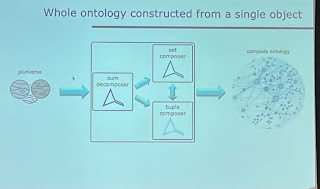 There is something named Ontology Sandbox that he uses to build ontologies.
Practical advantages and Issues to Overcome
- categorical transparency, dependency, reduction and consistency, as well as simplicity and explanatory
- however, these qualities are for the most part, broad theoretical advantages whose immediate practicality ius less obvious.
- cannot easily piggy-back on top ontology's semantic interoperability claim because the constructional turn did not change the base form of the top ontology.
This is according to him the best attempt to explain the proposed approach (more detail in the paper):
 The Mereology of Concepts: Preliminary Explorations
Guendalina Righetti
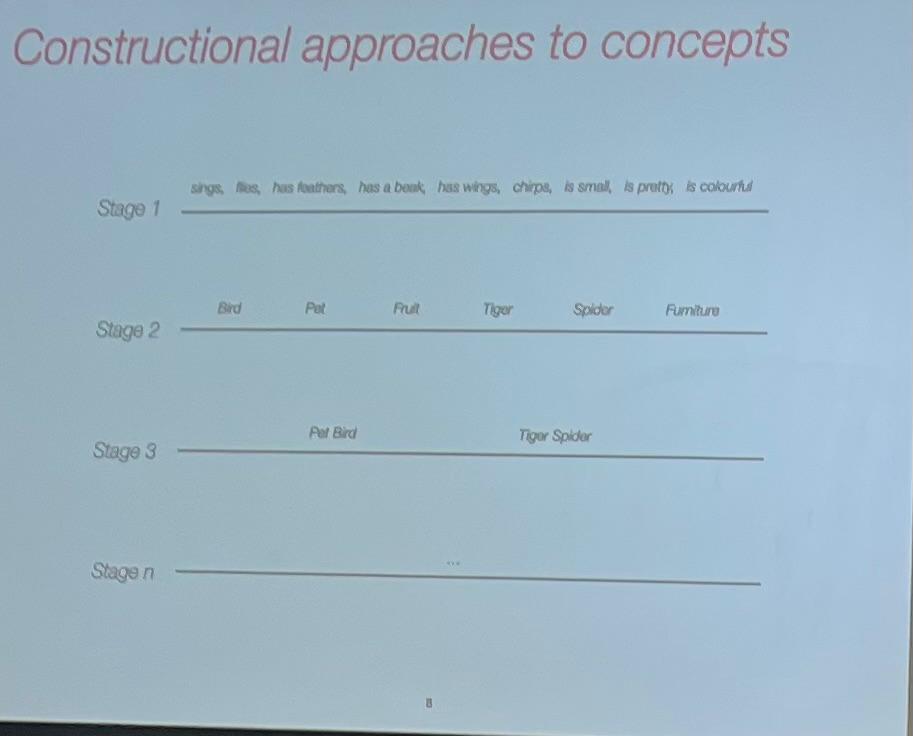
Different theories on concepts: for example Features vs. Concepts. While the first is an exemplar theory, the latter is a prototypical one.
The Mereology of Concepts: Preliminary Explorations
Guendalina Righetti
Different theories on concepts: for example Features vs. Concepts. While the first is an exemplar theory, the latter is a prototypical one.

 Do concepts have parts in the constructional perspective?
Rigid vs Variable Embodiments
Time absolute parthoold - sandwich example
rigid embodiment: a certain form R (principle of rigit embodiment) is embodied in some fixed matter)
slice1, slice2, ham/R
Time variable embodiment - river example (The variation of the amount of water in a river).
Variable environment of F: the object selecte dby ausuitable function F or principle (from times to things)
Another way of seeing this: Variable embodiment is not a new notion. The idea of this paper is to verify if this may also be used to conceive concepts. Example:
 When everything in a car is changed, is it still the same concept?
Semi-vriable embodiments - some parts can change but others are essential. E.g. "Nick Cave and The Bad Seeds" - Nick Cave is the essential part; In a concert, a band would be an essential part while the participants could vary.

(Chris Partridge, Andrew Mitchell, Sergio de Cesare, Andreas Cola, Mesbah Khan, Justin Price and Alexander Hierl)
Talk by Chris Partidge
Research Questions: What does it mean to have a constructional ontology in practice?
what are the practical advantages of adopting such an approach?
Constructionalism: Shifting the way an ontology is defined.

BORO
-includes a foundational (or upper) ontology and closely intertwined methodology for IS re-engeneering.
- was originally conceived in the late 1980s in a real world project.
Using BORO as a constructionalist ontology

Practical advantages and Issues to Overcome
- categorical transparency, dependency, reduction and consistency, as well as simplicity and explanatory
- however, these qualities are for the most part, broad theoretical advantages whose immediate practicality ius less obvious.
- cannot easily piggy-back on top ontology's semantic interoperability claim because the constructional turn did not change the base form of the top ontology.
This is according to him the best attempt to explain the proposed approach (more detail in the paper):


Rigid vs Variable Embodiments
Time absolute parthoold - sandwich example
rigid embodiment: a certain form R (principle of rigit embodiment) is embodied in some fixed matter)
slice1, slice2, ham/R
Time variable embodiment - river example (The variation of the amount of water in a river).
Variable environment of F: the object selecte dby ausuitable function F or principle (from times to things)
Another way of seeing this:


Semi-vriable embodiments - some parts can change but others are essential. E.g. "Nick Cave and The Bad Seeds" - Nick Cave is the essential part; In a concert, a band would be an essential part while the participants could vary.

segunda-feira, 15 de julho de 2024
Events Tutorial - Nicola Guarino - FOIS 2024
Event Perception
Perceptions of events accumulate in time.
Perceptions of objects superimpose each other in time.
e.g., I see Jan, I see that he removed the glasses.
Events
- happen in time
- only some proper parts are present whenevery they are present
- all parts are essential
- are uniquely located in spacetime
- do not need a time-idnexed parthood relation
- do not change in time (as a whole)
Quine/Davidson: Events are individuated by the space-temporal reagion where they occur (whatever happens in a spatio-temporal region)
Kim: No, in the same spacio-temporal region, there may be multiple events. On the other hand, Kim does not allow compositionality of events modifiers - warming up and warming up slowly denote two different events.
The most adopted view is still the Davidsonian view, due to the possibility of compositionality.
Facts vs. events
- Events are thick entities, being amenable to be described at different level of detail.
- Facts, on the contrary have a thin nature.
e.g. "The sfere rotates" and "the sfere rotates slowly" are two facts; but you may want to refer to it as the same event.
Bennett's intermediate positions: event descriptions are just names.
- For Bennet, ordinary events are still exemplification of properties, but not of the properties we use to name them.
- They are rather exemplifications of much more complex, unaccessible properties. Event descritptions are just names that, yby picking up some of these properties.
-an event and its description: the coonection just depends on "local context and unpricnipled intuitions"
- Bennett's book: Events and their Names
Is there a systematic relatioship between events and their names (typically verbs)?
Thesis: such core aspects of what happens are based ont he qualitative changes of objects. The systematic relationship between verbs and events ais grounded in qualitative changes.
A different approach: looking inside of events, independenctly of the properties they exemplify.
Question: what is the difference between "the sfere is rotating" and "the sfere is warming up"? The difference is in the quality being considered.
Individuating events
- One way to individuate is by looking at the participants. What are the relevant participants?
- There is a vagueness in trying to individuate minimal participants. e.g. in the Titanic collision, only a part of the boat (the front) and a part of the iceberg were involved in the collision. These parts are the minimal participatns.
- It is helpful to focus on local qualities instead, which are less vague.
Qualities
While properties hold, qualities exist.
Individual qualities survive to change. May be seen variable embodiements of tropes.
A qualitative change echibits a certain variation pattern. When the quality is stable within a certain threshold, we say the quality is unchanged. So this notion also incorporates the notion of unchange.
 We can still say events are redefinition of properties but this is not wha an event is..
To summarize: Complex events and their synchronic structure
- Qualitative changes are the simplest case of events.
- Ordinary events typically have a more complex strcuture, since we tend to cluster together multiple coginitively relevant qualitiative changes.
- Complex events are sums of qualitative changes within them, we distinguish: a) scenes, and
b) cogntively relevant complex events whose individuation criterrie are provided by event kinds (which are cognitive constructions.
Focal event vc. internal context
- focal event - it is what the kind primarily describes.
- internal context - the way the focal event occurs (there are other events involved, besides the focal event).
structure:

Perceptions of events accumulate in time.
Perceptions of objects superimpose each other in time.
e.g., I see Jan, I see that he removed the glasses.
Events
- happen in time
- only some proper parts are present whenevery they are present
- all parts are essential
- are uniquely located in spacetime
- do not need a time-idnexed parthood relation
- do not change in time (as a whole)
Quine/Davidson: Events are individuated by the space-temporal reagion where they occur (whatever happens in a spatio-temporal region)
Kim: No, in the same spacio-temporal region, there may be multiple events. On the other hand, Kim does not allow compositionality of events modifiers - warming up and warming up slowly denote two different events.
The most adopted view is still the Davidsonian view, due to the possibility of compositionality.
Facts vs. events
- Events are thick entities, being amenable to be described at different level of detail.
- Facts, on the contrary have a thin nature.
e.g. "The sfere rotates" and "the sfere rotates slowly" are two facts; but you may want to refer to it as the same event.
Bennett's intermediate positions: event descriptions are just names.
- For Bennet, ordinary events are still exemplification of properties, but not of the properties we use to name them.
- They are rather exemplifications of much more complex, unaccessible properties. Event descritptions are just names that, yby picking up some of these properties.
-an event and its description: the coonection just depends on "local context and unpricnipled intuitions"
- Bennett's book: Events and their Names
Is there a systematic relatioship between events and their names (typically verbs)?
Thesis: such core aspects of what happens are based ont he qualitative changes of objects. The systematic relationship between verbs and events ais grounded in qualitative changes.
A different approach: looking inside of events, independenctly of the properties they exemplify.
Question: what is the difference between "the sfere is rotating" and "the sfere is warming up"? The difference is in the quality being considered.
Individuating events
- One way to individuate is by looking at the participants. What are the relevant participants?
- There is a vagueness in trying to individuate minimal participants. e.g. in the Titanic collision, only a part of the boat (the front) and a part of the iceberg were involved in the collision. These parts are the minimal participatns.
- It is helpful to focus on local qualities instead, which are less vague.
Qualities
While properties hold, qualities exist.
Individual qualities survive to change. May be seen variable embodiements of tropes.
A qualitative change echibits a certain variation pattern. When the quality is stable within a certain threshold, we say the quality is unchanged. So this notion also incorporates the notion of unchange.
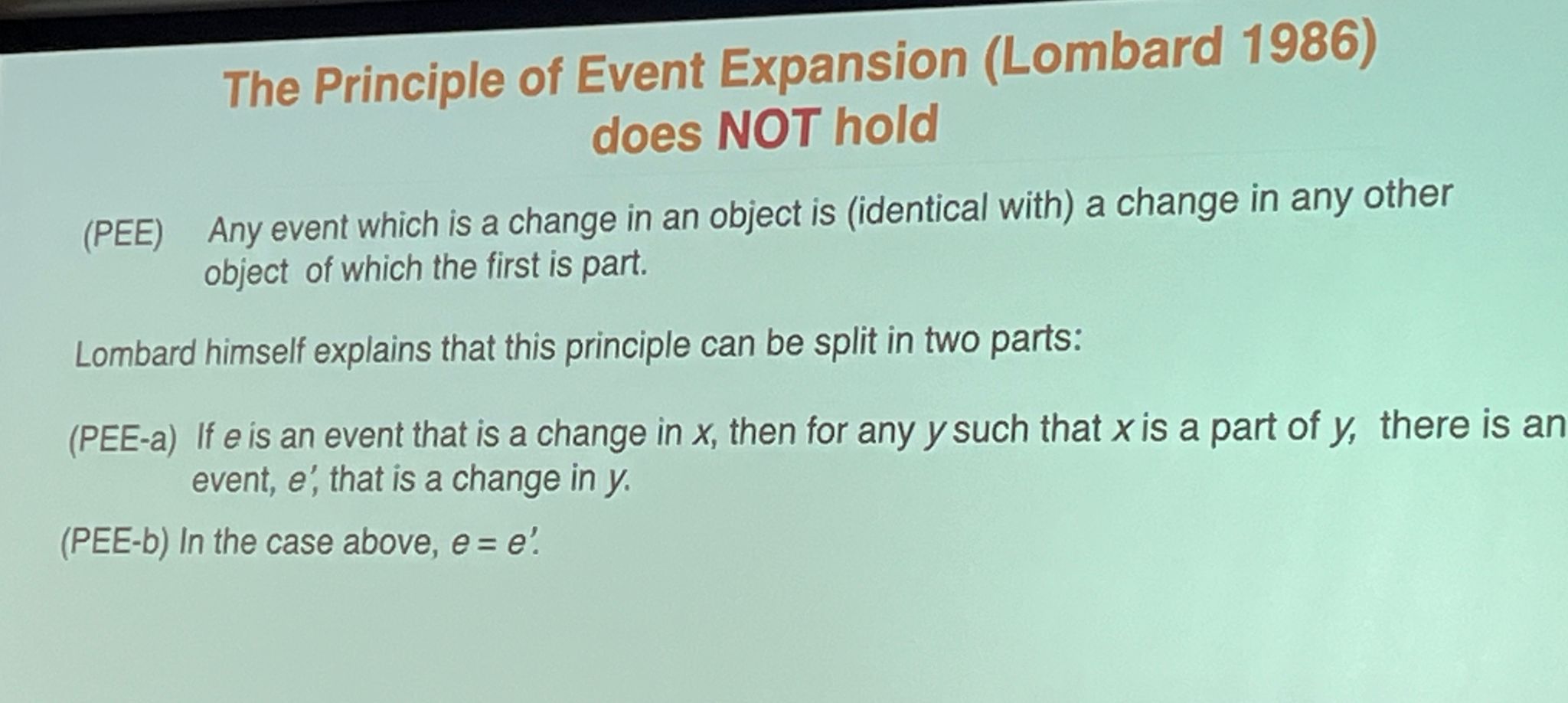
To summarize:

- Qualitative changes are the simplest case of events.
- Ordinary events typically have a more complex strcuture, since we tend to cluster together multiple coginitively relevant qualitiative changes.
- Complex events are sums of qualitative changes within them, we distinguish: a) scenes, and
b) cogntively relevant complex events whose individuation criterrie are provided by event kinds (which are cognitive constructions.
Focal event vc. internal context
- focal event - it is what the kind primarily describes.
- internal context - the way the focal event occurs (there are other events involved, besides the focal event).
structure:

JOWO - IFOW - Session 1
What is Food - Adrien Barton
- Context of OBO Foundry
- What do the things we eat have in common?
Part I - Food-related dispositions
1)Edibility - a physical quality inhering in a bearer by virtue of the bearer's disposition of being fit to be consumed. Who is going to consume? Animal, human?
Edibility_for_humans - ... to be consumed by a typical human
Edibiliity_for_P1 (P1 may be related to a particular health condition or intolerance)
Coming to and out of existence of edibility
Edibility is a matter of degree and quantity
Partial edibility - e.g. avocado is partially edible, because you must peal it and remove the seed.
2)Nutritiveness - a disposition borne by a material entity that is realized by providing nutrients when being consumed by a typical human.
- Edibility characterizes the absence of negative consequence.
- Nutritiveness characterizes the existence of a positive consequence.
3) Palatability
This is very culture and individual-relative
Palatability depends on the circumstances (perhaps not a typical disposition)
4) Other food related disposition
phsychoactive effect, energetic effect etc.
These food dispositions are all independent from each other (he gives examples)
Part II - Food role
Appropriate food role - a role of a material entity of a type that is generally considered by some community as appropriate for consumption by ingestion in order to fulfill nutritional needs and/or to provide organoleptic experience.
They justify having this as a role (not property) because of the relational nature of this concept.
Reference:
Borghini A. and Piras, N (2020) Food and foods. Toward a definition. Rivista italiana di Filosofia del Linguaggio.
They take the Social-based view of food perspective explained by Borghini and Piras (2020), while not agreeing with the other definitions they provide. Between Input and Output: The Importance of Modelling Transients in Meal Preparation Tasks - Michaela Kümpel
- The goal of this research is to enable robots to prepare meals.
- Towards this,: developed a food cutting knowledge graph (AKR3 2024)
- Robots can use the graph to perform task variations (there is a demo in the website)
The demo shows that different properties from the objects are considered. For example, to "cut a banana", the demo considers that the banana has a peal, so it must be pealed first. Then, the action of slicing is explained step by step: taking a knife, putting the knife up, putting the knife down etc. The live demo also simulates the robot cutting the fruit.
- FoodOn workgroup researchers converting food-related processes into steps
- She claims that "transients" need to be considered, in the sense that in a recipe, before ingredients compose a dough, it becomes a transient while it is being mixed. She explains some logic formulas defining transients.
- Then she presents an ontological model of transients, using an ad-hoc language, exemplifying the model with the example of the dough.
Benefits of the integration of transients
- increased failure handling
- added information abou initial conditions, intermediate transitions and outcomes
It is interesting that the transits have the same parts as the produced object, but it is not the same. It has some properties that the result does not have, for example, the ability to recognize the ingredients that are being mixed.
Nicola: Linguistics does not recognize this, it seems not to be natural. For example, when putting the cake in the oven, it is already referred the cake as such, although it is not yet done.
She claims that for the robot, it is important to understand the objects in the intermediate states are different, so that they still need to do something about them to transform them into the resulting object.
A Food as Medicine Ontology built on Traditional Chinese Medicine Energetics and Food Actions - Neil Sarkar
- In ancient Egypt, the way people eat and relate to food was considered when practicing medicine. In Chinese medicine, depending on what you eat, that can impact your health. The state of the food (heat, consistency) is also considered in Chinese Medicine for understanding the relation to the health issue/condition. This is very different in modern medicine, which tries to fix a problem with medications, instead of trying and understanding why people are getting sick. For instance, some conditions may be avoided or cured by specific types of diets.
- Cool lunches may help sooth your body and relieve stress.
- Greek Four Humours: depending on the food, you may find a balance between these four humours.
Is there any formal framework that can be used to capture this dependence between health and food?
- Zhen Qi in chinese medicine means balance.
- The correspondence in modern medicine for the chinese concept of Zhen Qi is resilence.
It is important not only treat the patient's illness, but support them throughout the way.
He presented a taxonomy starting from Gu Qi (diet):
 He also mapped a data repository of Medicinal Food ingredients and connected it to the ontology.
Physical, Organoleptic, and Taxonomical Food Characteristic Analysis for Ontologies and Research - Damion Doole
He is from Genomics and One Health, SFU

His work integrates a myriad of ontologies in food and related areas. The main food ontology, also cited in the previous presentatios is FoodOn.
- Is mouthfeel a esult of a combination of mastication-related senses
- What characteristics do "seeing" and "touching" cover? Texture, color etc.
There is a module on Diets:
- Diet by digestive capacity
- Diet by type of food
- Diet by nutrition composition
- Diet by agricultural treatment
- Prescriptive vs. Descriptive Diet
- Context of OBO Foundry
- What do the things we eat have in common?
Part I - Food-related dispositions
1)Edibility - a physical quality inhering in a bearer by virtue of the bearer's disposition of being fit to be consumed. Who is going to consume? Animal, human?
Edibility_for_humans - ... to be consumed by a typical human
Edibiliity_for_P1 (P1 may be related to a particular health condition or intolerance)
Coming to and out of existence of edibility
Edibility is a matter of degree and quantity
Partial edibility - e.g. avocado is partially edible, because you must peal it and remove the seed.
2)Nutritiveness - a disposition borne by a material entity that is realized by providing nutrients when being consumed by a typical human.
- Edibility characterizes the absence of negative consequence.
- Nutritiveness characterizes the existence of a positive consequence.
3) Palatability
This is very culture and individual-relative
Palatability depends on the circumstances (perhaps not a typical disposition)
4) Other food related disposition
phsychoactive effect, energetic effect etc.
These food dispositions are all independent from each other (he gives examples)
Part II - Food role
Appropriate food role - a role of a material entity of a type that is generally considered by some community as appropriate for consumption by ingestion in order to fulfill nutritional needs and/or to provide organoleptic experience.
They justify having this as a role (not property) because of the relational nature of this concept.
Reference:
Borghini A. and Piras, N (2020) Food and foods. Toward a definition. Rivista italiana di Filosofia del Linguaggio.
They take the Social-based view of food perspective explained by Borghini and Piras (2020), while not agreeing with the other definitions they provide. Between Input and Output: The Importance of Modelling Transients in Meal Preparation Tasks - Michaela Kümpel
- The goal of this research is to enable robots to prepare meals.
- Towards this,: developed a food cutting knowledge graph (AKR3 2024)
- Robots can use the graph to perform task variations (there is a demo in the website)
The demo shows that different properties from the objects are considered. For example, to "cut a banana", the demo considers that the banana has a peal, so it must be pealed first. Then, the action of slicing is explained step by step: taking a knife, putting the knife up, putting the knife down etc. The live demo also simulates the robot cutting the fruit.
- FoodOn workgroup researchers converting food-related processes into steps
- She claims that "transients" need to be considered, in the sense that in a recipe, before ingredients compose a dough, it becomes a transient while it is being mixed. She explains some logic formulas defining transients.
- Then she presents an ontological model of transients, using an ad-hoc language, exemplifying the model with the example of the dough.
Benefits of the integration of transients
- increased failure handling
- added information abou initial conditions, intermediate transitions and outcomes
It is interesting that the transits have the same parts as the produced object, but it is not the same. It has some properties that the result does not have, for example, the ability to recognize the ingredients that are being mixed.
Nicola: Linguistics does not recognize this, it seems not to be natural. For example, when putting the cake in the oven, it is already referred the cake as such, although it is not yet done.
She claims that for the robot, it is important to understand the objects in the intermediate states are different, so that they still need to do something about them to transform them into the resulting object.
A Food as Medicine Ontology built on Traditional Chinese Medicine Energetics and Food Actions - Neil Sarkar
- In ancient Egypt, the way people eat and relate to food was considered when practicing medicine. In Chinese medicine, depending on what you eat, that can impact your health. The state of the food (heat, consistency) is also considered in Chinese Medicine for understanding the relation to the health issue/condition. This is very different in modern medicine, which tries to fix a problem with medications, instead of trying and understanding why people are getting sick. For instance, some conditions may be avoided or cured by specific types of diets.
- Cool lunches may help sooth your body and relieve stress.
- Greek Four Humours: depending on the food, you may find a balance between these four humours.
Is there any formal framework that can be used to capture this dependence between health and food?
- Zhen Qi in chinese medicine means balance.
- The correspondence in modern medicine for the chinese concept of Zhen Qi is resilence.
It is important not only treat the patient's illness, but support them throughout the way.
He presented a taxonomy starting from Gu Qi (diet):

Physical, Organoleptic, and Taxonomical Food Characteristic Analysis for Ontologies and Research - Damion Doole
He is from Genomics and One Health, SFU

His work integrates a myriad of ontologies in food and related areas. The main food ontology, also cited in the previous presentatios is FoodOn.
- Is mouthfeel a esult of a combination of mastication-related senses
- What characteristics do "seeing" and "touching" cover? Texture, color etc.
There is a module on Diets:
- Diet by digestive capacity
- Diet by type of food
- Diet by nutrition composition
- Diet by agricultural treatment
- Prescriptive vs. Descriptive Diet
quinta-feira, 16 de maio de 2024
How Data Analytics and Data Science Fit: A Join Research Methodological Perspective - By Faiza Bukhsh and Maya Daneva
Definition:
Design Science is the design and inestigation of artifacts in context.
Design - design/investigate scinticif methods processes, algorithms.
Investigation - investigat from noisy, structure and unstructured data
Artifacts - extract or extrapolate knowledge and insights
Context - apply in context the knowlede grom data across a broad range of application domains.
There are different perspectives to define/use Data Science, depending on your field. See figure below: The basic phases of Data Analytics can also be seen as the basic phases of Design Science (it really depends on the project how to frame each phase. For instance, for a software, the phases have to do with software development)
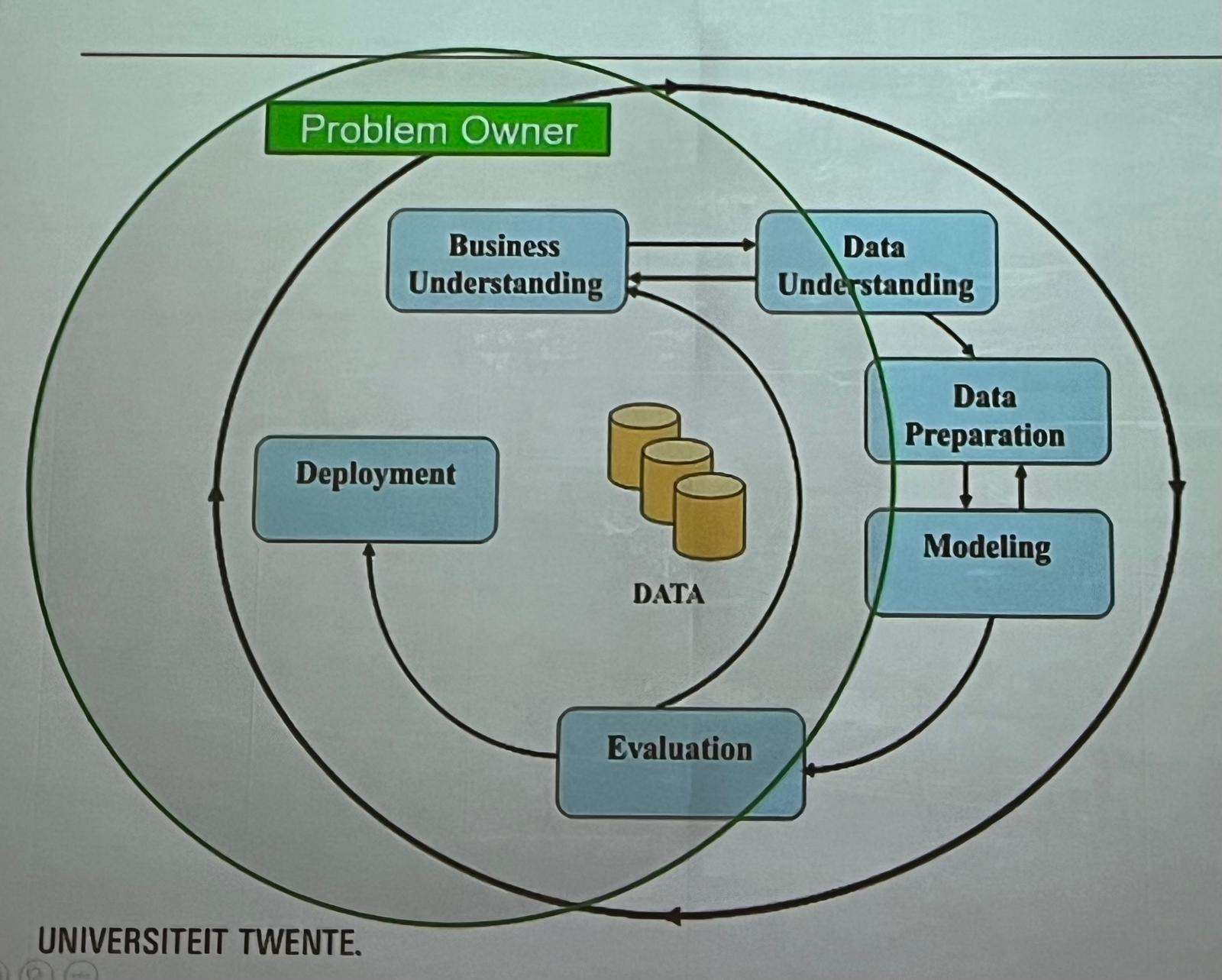
 CRISP-DM: a method of Data Mining, which proposes a life cycle which is similar to any design project. It comprehends Business Understandingg, Dta Understanding, Data Preparation, Data Modeling, Evaluation and Deployment. It is an iterative and cyclic process. See figure below:
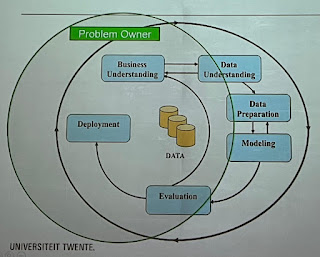 Different roles are responsible for each activity but they should also collaborate and participate in each other activities. Example:
 Many times, the problem happens because the data is not well-prepared. We get excited to run our model and train it, but if the data is noisy, not well-prepared, you will never achieve the accuracy that you are looking for. So you should stop doing mindless effort and go back to data preparation.
For acquiring data, there are a few possibilities. One solution she made with a hospital is having the data aways on their site on a particular server and then she can access it through a VPN. But for privacy issues, she cannot access the data itself, only the results of the application of algorithms.
*This seems like a promising solution
There is also another interesting methodology which has the same phases, but what is special about it is that it always loops back to a previous activity. See figure:
Many times, the problem happens because the data is not well-prepared. We get excited to run our model and train it, but if the data is noisy, not well-prepared, you will never achieve the accuracy that you are looking for. So you should stop doing mindless effort and go back to data preparation.
For acquiring data, there are a few possibilities. One solution she made with a hospital is having the data aways on their site on a particular server and then she can access it through a VPN. But for privacy issues, she cannot access the data itself, only the results of the application of algorithms.
*This seems like a promising solution
There is also another interesting methodology which has the same phases, but what is special about it is that it always loops back to a previous activity. See figure:
 There is a very interesting method called SEMMA. Sample, Explore, Modify, Model and Assess. They have a setp-by-step guidance of how to tackle each phase:
 She mentions four methodologies for Design Science. Among them, Roel Wieringa's, Paul Johanssen's and Peffer's.
let's start with Paul Johanssen's method
She mentions four methodologies for Design Science. Among them, Roel Wieringa's, Paul Johanssen's and Peffer's.
let's start with Paul Johanssen's method
 Paul's model has a lot of cycles on it. The Data Science methods also have cylces. So we can start analyzing in which parts of one model we can insert the other.
Peffers Design Cycle
Paul's model has a lot of cycles on it. The Data Science methods also have cylces. So we can start analyzing in which parts of one model we can insert the other.
Peffers Design Cycle
 Wieringa's method:
 In the work of Wieringa, data analysis will be in the treatment design, since this is where you do the modeling, the training and the tunning. But if you are going for a knowledge problem, then it means that you are trying to extract knowledge from knowledge (so something like LLM). Then, data analysis is in the setup phase (for LLM, it will be prompt engineering).
How can I know what my artifact is? (the artifact that should be designed)
In the work of Wieringa, data analysis will be in the treatment design, since this is where you do the modeling, the training and the tunning. But if you are going for a knowledge problem, then it means that you are trying to extract knowledge from knowledge (so something like LLM). Then, data analysis is in the setup phase (for LLM, it will be prompt engineering).
How can I know what my artifact is? (the artifact that should be designed)
It all depends on the objective. You have to ask yourself what is the goal of that design project.
What is my artifact?
The artifact in a Data Analytics project can be the Data preparation process itself, it can be the model or the model result, it can be the evaluation process or evaluation criteria. So we have to ask ourselves again what the objective is. And then you will know what is your artifact.
Design - design/investigate scinticif methods processes, algorithms.
Investigation - investigat from noisy, structure and unstructured data
Artifacts - extract or extrapolate knowledge and insights
Context - apply in context the knowlede grom data across a broad range of application domains.
There are different perspectives to define/use Data Science, depending on your field. See figure below:




It all depends on the objective. You have to ask yourself what is the goal of that design project.
What is my artifact?
The artifact in a Data Analytics project can be the Data preparation process itself, it can be the model or the model result, it can be the evaluation process or evaluation criteria. So we have to ask ourselves again what the objective is. And then you will know what is your artifact.
Keynote by Carlos Ribas (Bosch) - The power of Information Systems shaping the future of the Automative Industry
He presented dan interesting tool called Bmlp associated with an operating system named TOM to automate smart factories. Read about it here:
https://www.iotm2mcouncil.org/iot-library/news/connected-industries-news/bosch-commits-to-global-industrial-aiot/
He also discussed how Bosch inveted in Digital Twins to help having more prompt predictions of failures in their factories. Read about it here: https://www.bosch-connected-industry.com/de/en/iiot-insights/digital-twins
He talked about the role of AI in Manufacturing Examples of use:
 He also mentioned that none of this is important if tecnhology does not improve the life or work of people who work in the factories.
 Digital twins can help simulate in the lab before the equipment is put in the plant. The other use is in real-time data acquisition. For example, when the equipment is put to test, at the same time, they can inspect data coming from the test and discover on the flight. And they will know that in a particular component, under specific conditions, they have errors. This is really helpful for them.
They treat data integration in these terms: from each sensor, data is sent to data repositories in specific format and also adding labels. This facilitates recover data from different apps, different systems. *It seems to me they treat this in the syntactic level.
I also found a link to an interesting data platform: https://www.bosch-connected-industry.com/de/en/portfolio/bosch-semantic-stack
I wonder if there are some more sophisticated semantic technologies in place, of which perhaps Carlos is not aware.
They can detect a problem in the process, not after the process is finished. That is why they feel so much in control. The faulty components are immediately rejected, removed from the process, suffer maintenance, and then go back to the process.
They are not currently investing in LLM because they do not feel the need. Sometimes the volume of data being too high, it does not help.
The people who used to work in the plant doing mechanical work are still there, and they are trained and "re-skilled". In the last years, the process of training has been very intensive. Sometimes, they are not learning new things very easily, but Bosch sees this is a mission. If they do not
People need to develop different competencies. In the future, in the recruitment process, new people need to come with a degree. Currently, many of them are low level engineers (now the work force is 40% of people have at least a degree). They need to gain knowledge about the new technologies. This is a must!
Alessandro Oltramani, an expert in logic-symbolic reasoning is the new leader of the Carnegie Bosch Institute: https://carnegiebosch.cmu.edu/
Giancarlo asked if this shows that such kind of approach is a current bet of Bosch. Carlos responded that is for sure.
He also discussed how Bosch inveted in Digital Twins to help having more prompt predictions of failures in their factories. Read about it here: https://www.bosch-connected-industry.com/de/en/iiot-insights/digital-twins
He talked about the role of AI in Manufacturing


They treat data integration in these terms: from each sensor, data is sent to data repositories in specific format and also adding labels. This facilitates recover data from different apps, different systems. *It seems to me they treat this in the syntactic level.
I also found a link to an interesting data platform: https://www.bosch-connected-industry.com/de/en/portfolio/bosch-semantic-stack
I wonder if there are some more sophisticated semantic technologies in place, of which perhaps Carlos is not aware.
They can detect a problem in the process, not after the process is finished. That is why they feel so much in control. The faulty components are immediately rejected, removed from the process, suffer maintenance, and then go back to the process.
They are not currently investing in LLM because they do not feel the need. Sometimes the volume of data being too high, it does not help.
The people who used to work in the plant doing mechanical work are still there, and they are trained and "re-skilled". In the last years, the process of training has been very intensive. Sometimes, they are not learning new things very easily, but Bosch sees this is a mission. If they do not
People need to develop different competencies. In the future, in the recruitment process, new people need to come with a degree. Currently, many of them are low level engineers (now the work force is 40% of people have at least a degree). They need to gain knowledge about the new technologies. This is a must!
Alessandro Oltramani, an expert in logic-symbolic reasoning is the new leader of the Carnegie Bosch Institute: https://carnegiebosch.cmu.edu/
Giancarlo asked if this shows that such kind of approach is a current bet of Bosch. Carlos responded that is for sure.
Assinar:
Postagens (Atom)